🎄 DIY Christmas Wreath: Craft Yours in Just 30 Minutes! ✂️✨
Posted on November 25, 2025 · by Mason Lee

BOENFU 6 Inches Wire Cutters Heavy Duty Snips Flush Cut Side Cutters Pliers Metal Cutting Tool for Crafting, Floral, Artificial Flowers, Chicken Wire, Electrical, 1 Pack
$5
https://www.amazon.com/dp/B07C5PM8L4?tag=neuchcup-21

Surebonder Cordless Hot Glue Gun, High Temperature, Full Size, 60W, 50% More Power - Sturdily Bonds Metal, Wood, Ceramics, Leather & Other Strong Materials (Specialty Series CL-800F)
$19
https://www.amazon.com/dp/B001AH5EXK?tag=neuchcup-21
5 Quick Steps to a Christmas Wreath You Can Finish in 30 Minutes 🎄
Make a festive, handmade wreath in 30 minutes by following five focused steps that prioritize speed and impact. Start by choosing a sturdy wreath form like a grapevine or wire hoop—this single decision determines how fast the project will move and how much filler is required.
The first action is to decide the focal element: a small handpainted sign, a large bow, or a cluster of ornaments will anchor the design and instantly make the wreath look finished.
Step 1: Select one focal piece and commit
Choose a focal piece first because it reduces decision fatigue and speeds assembly. For example, a reindeer sign makes a rustic wreath instantly readable from the street, while a plush bow creates a soft, festive silhouette.
Refer to tutorials for quick ideas and placement tips, such as the step-by-step approach shown on a 30 minute Christmas wreath tutorial that demonstrates positioning and attachment tricks for a grapevine wreath.
Step 2: Use three types of greenery for texture
Limit greenery to three textures—for example, pine, eucalyptus, and a berry sprig—to create depth without overcomplicating the build. This combination gives color variation and a professional look with minimal trimming.
Cut branches into uniform 4–6 inch pieces using pruners and arrange them around your form to test the look before attaching permanently.
Step 3: Attach the focal piece securely
Secure the focal piece first with zip ties, pipe cleaners, or a bracket system so the rest of the wreath can be balanced around it. If the sign lacks pre-drilled holes, add small zip tie brackets at contact points.
Practical attachments and the option to hide fasteners behind vines are covered in many DIY guides like the technique notes found on simple DIY wreath tutorials.
Step 4: Build a quick bow and tuck greenery
Create a fluffy bow fast by pulling loops forward and bringing tails to the back, then secure with florist wire. Tuck small sprigs into the bow loops and glue them with a hot glue gun for extra hold.
Placing the bow opposite the sign creates a classic diagonal balance that reads well from a distance.
Step 5: Add three ornament clusters for polish
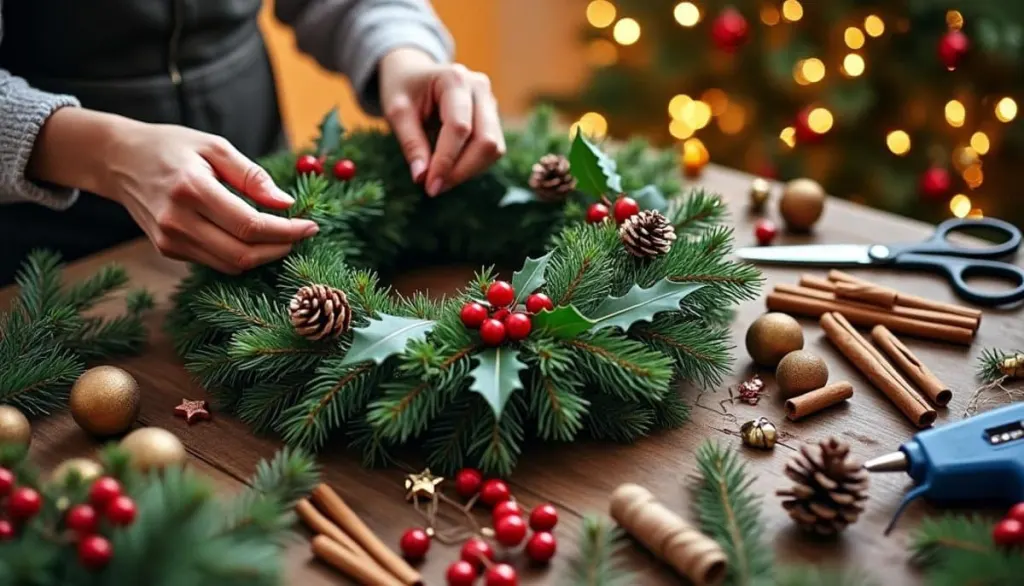
Finalize with three ornament clusters rather than many scattered pieces; this keeps the visual calm while still adding shine. Use groups of small baubles, pine cones, and berries glued or wired in place.
For visual inspiration on cohesive ornament placement, check curated galleries like seasonal wreath ideas. Pin for later! 📌
3 Essential Supplies for a Quick Wreath That Won’t Break the Budget 💸
Choose three reliable categories of supplies—form, fasteners, and focal accents—to guarantee a fast build and a polished result. Investing a little in these categories saves time and prevents last-minute runs to the craft store.
Start with the wreath form: a painted grapevine or a wire hoop gives different bases. A grapevine offers rustic texture and natural hiding spots for attachments. A wire hoop is faster to dress and lighter on the door.
Form: grapevine vs wire hoop vs foam
Pick grapevine for rustic looks and wire hoop for speed. A foam ring is useful for beginners since it accepts hot glue and pins—but it can feel bulkier and less natural than woven vines.
Reference the variety of forms and their pros in expert how-to pages like a step-by-step wreath guide that outlines forms and matching techniques.
Fasteners and tools to keep on hand
Always have zip ties, florist wire, pipe cleaners, and a hot glue gun ready. These four fasteners are the backbone of a quick wreath: zip ties secure heavy focal pieces, florist wire creates invisible holds, pipe cleaners are perfect for temporary placement, and hot glue locks small accents instantly.
Wire cutters and pruners are non-negotiable to trim stems quickly and create clean attachment points.
Focal accents that read from the street
Choose accents that read at a distance: bold bows, signs, or 2–3 large ornaments. Small trinkets disappear once the wreath is on a busy porch; large accents keep the wreath visually strong.
Find budget inspiration and product ideas from accessible resources like easy DIY wreath projects and creative supply lists that focus on inexpensive but striking items.
Before moving to assembly, place all supplies on a craft mat and group them into “attach now” and “attach later” piles. This visual order saves minutes and reduces mistakes. 🔧
4 Clever Bow & Sign Techniques That Transform a Quick Wreath ✨
Employ four practical techniques to make a bow or sign look professionally placed and secure in under 10 minutes. These techniques emphasize speed, symmetry, and a confident final look.
Technique one: attach a sign with a bracket and pipe cleaners so it sits flush. This avoids lumps and keeps the sign stable in wind.
Technique 1: Bracket and pipe cleaner method
Use small zip tie brackets or glued brackets behind the sign. Mark the contact points, adhere brackets with hot glue, then thread pipe cleaners through and twist behind the wreath to hide the fastener.
Examples of this approach can be found in fast-tutorial walk-throughs such as practical how-to pages that show bracket placement and concealment.
Technique 2: A quick “Funky Bow” that looks full
Pull ribbon loops forward and tails back to instantly fluff a bow. Clamp the center with florist wire and then attach the whole bow with additional wire or a zip tie to the wreath armature.
For ribbon choices, wired ribbon is best because it holds shape; choose widths between 2.5–4 inches for instant drama.
Technique 3: Tuck instead of glue for easy adjustments
Tuck greenery stems under vine arms rather than gluing every piece. This saves glue time and allows repositioning if the wreath is shifted on the door. Use hot glue only for heavier or fragile ornaments.
This method supports a quick wreath approach where speed and future repairability are both priorities.
Technique 4: Hide fasteners for a clean finish
Conceal zip ties and wires behind ribbon folds or deeper vine layers. A clean backside makes the wreath more durable and visually appealing from several angles.
When the wreath is complete, step two steps back and check for silhouette balance. A wreath that reads well at a glance will draw compliments and photos—perfect for holiday shares on Pinterest and social feeds. 📸
2 Fast Assembly Methods for a Festive, Durable Wreath 🛠️
Pick one of two assembly strategies—speed layering or anchored focal—based on time constraints and the level of detail desired. Both methods yield a beautiful handmade wreath suitable for outdoor seasonal decoration.
The speed layering method excels when limited to a 30-minute window and a single crafter. The anchored focal method is best when a sign or heavy accent defines the project.
Method A: Speed layering for a quick wreath
Layer greenery in thirds around the form, securing each group with florist wire. Start with a base of longer pine sprigs, add mid-length eucalyptus for color, and finish with short berry stems for highlights.
This method is efficient because each wire attaches several stems at once, reducing individual attachment time. See applied examples on community galleries like creative DIY collections for visual cues on proportion and spacing.
Method B: Anchored focal assembly
Attach the focal element first, then build greenery and accents around it for immediate cohesion. This strategy makes it easier to maintain balance and results in a wreath that looks intentional and styled.
When using this approach, attach the bow opposite the sign to create diagonal visual interest. Small greenery springs tucked into the bow loops elevate the bow and connect it to the wreath body.
Both methods benefit from a single final step: a secure sweep of hot glue on heavier ornaments and a gentle shake test to ensure nothing shifts in transit to the door.
5 Pro Tips to Make Your Easy Christmas Project Look Store-Bought 🎁
Apply five professional tips that elevate a quick wreath into a polished, photograph-ready piece of festive decor. These tips focus on proportion, texture, color harmony, durability, and display strategy.
Tip one: scale matters—choose focal pieces that are proportionate to the wreath diameter so the design reads from a distance.
Tip 1: Use scale and repetition wisely
Repeat one accent three times for rhythm and use one large focal to anchor the composition. For example, use three clusters of red berries and one bold burlap bow so the eye moves smoothly around the wreath.
Repetition acts like a visual beat and increases perceived craftsmanship.
Tip 2: Mix textures for depth
Combine glossy ornaments, soft ribbon, and rough pine cones to create dimensional contrast. Layering textures invites the viewer to look closer and gives the wreath a luxe feel even when made quickly.
Curated inspiration for texture mixing is available in seasonal roundups such as DIY gallery posts.
Tip 3: Choose long-lasting materials for outdoor display
Select silk greenery and weatherproof ribbon for porch wreaths. This choice prevents color fade and keeps the piece looking fresh throughout the season, especially in milder winter climates in 2025.
If using fresh greens, plan on relocating the wreath to a protected area during storms to prolong its life.
Tip 4: Mind the door hardware and hanging method
Match the wreath hanger to door hardware and distribute weight evenly. A reinforced hook and a hidden back loop made from florist wire will keep a heavier sign-centered wreath from sagging.
Front-porch styling examples and hanging solutions are illustrated on décor pages like front porch holiday guides.
Tip 5: Photograph and share for repeatable success
Photograph the wreath in natural light and record supply sources so the project can be remade or scaled. Sharing a clear supply list and a time estimate encourages saves and clicks—perfect for Pinterest-driven engagement.
For more seasonal inspiration and variations beyond traditional greenery, explore style ideas such as wreath ideas beyond green and cozy aesthetics like cozy Christmas aesthetic. Save for reference! 📌
About the author
Mason Lee shares practical ideas designed to work in real life.
Explore
Latest ideas
🎄 Cozy Christmas PJs: Ultimate Holiday Comfort! 🛌
🎄 Ultimate Christmas Gift Guide: Perfect Ideas for Everyone! 🎁
🎄DIY Christmas Ornaments: Fun Crafts for Every Age!✨
🎁 Office-Friendly Christmas Gifts for Coworkers 🎄